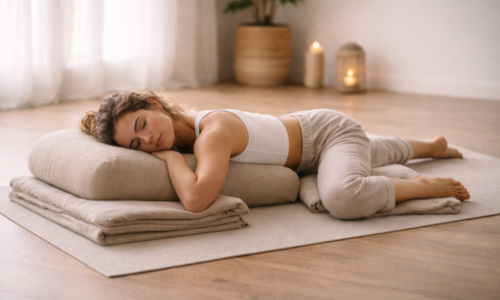
Restorative Yoga is a gentle and deeply calming style of yoga that focuses on complete relaxation of the body and mind. Unlike active yoga styles, it uses long-held supported poses that allow the body to fully rest and recover.
It is especially helpful for reducing stress, improving sleep, and healing physical and mental fatigue.
Table of Contents
- What Is Restorative Yoga?
- How Restorative Yoga Works
- Why Deep Relaxation Is Important
- Benefits of Restorative Yoga
- Common Restorative Yoga Poses
- Who Should Practice It
- Conclusion
What Is Restorative Yoga?
Restorative Yoga is a slow and supportive form of yoga where the body is fully supported using props like cushions, blankets, and blocks. Poses are held for several minutes without effort.
The goal is not movement or stretching, but complete relaxation and recovery.
How Restorative Yoga Works
Restorative Yoga works by activating the body’s natural relaxation response. When you stay still in comfortable positions, the nervous system shifts from “stress mode” to “rest mode.”
- Body becomes fully supported
- Muscles completely relax
- Breathing becomes slow and deep
- Mind enters a calm state
y=Restorative Yoga supported poses for deep nervous system relaxation
This helps the body heal and recharge naturally.
Why Deep Relaxation Is Important
Modern lifestyles often create constant stress and mental pressure. Without proper relaxation, the body can become exhausted over time.
Deep relaxation helps:
- Reduce stress levels
- Improve sleep quality
- Restore energy
- Balance emotions
- Improve mental clarity
Restorative Yoga provides this relaxation in a structured way.
Benefits of Restorative Yoga
| Benefit | How It Helps |
|---|---|
| Deep Relaxation | Calms nervous system |
| Stress Relief | Reduces mental tension |
| Better Sleep | Improves sleep quality |
| Faster Recovery | Helps body heal |
| Emotional Balance | Reduces anxiety |
It is one of the most healing forms of yoga.
Common Restorative Yoga Poses
Here are some popular restorative yoga poses:
- Supported Child’s Pose
- Legs-Up-The-Wall Pose
- Supported Bridge Pose
- Reclining Butterfly Pose
- Savasana (Deep Relaxation Pose)
These poses are usually held for 5–15 minutes each.
Who Should Practice It
Restorative Yoga is ideal for:
- People with high stress or anxiety
- Beginners looking for gentle yoga
- Individuals recovering from fatigue
- People with sleep issues
- Anyone needing deep relaxation
It is safe and suitable for all age groups.
Conclusion
Restorative Yoga is a powerful practice for deep relaxation and healing. By using supported poses and long periods of stillness, it helps calm the nervous system, reduce stress, and restore energy.
In a busy and stressful world, Restorative Yoga offers a much-needed pause for the body and mind. Regular practice can improve sleep, emotional balance, and overall well-being, making it an essential part of a healthy lifestyle.